I wrote a post for Girlie Girl Army that I wanted to re-share on my website. It’s a piece for parents who are raising vegan kids. I hope it will give you the courage and pride to raise a child according to principles of integrity and compassion. Here it is!
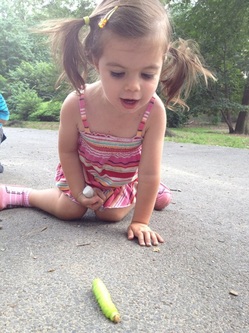
"Teaching a child not to step on a caterpillar is as valuable to the child as it is to the caterpillar." -- Bradley Miller
ORIGINAL ON Girlie Girl Army:
"When I tell people that I’m raising my child vegan, I sometimes feel as though I have to defend and explain my decision. My decision is passive, I'm just leaving out certain foods from her diet. But parents who are feeding their kids meat, dairy, and eggs are actively adding in foods. So shouldn’t it be the other way around? Shouldn’t they have to defend their decision to purchase that hot dog that came from a pig who never stepped foot on grass or saw the sky (except from the slot in the truck on her way to the slaughterhouse) and whose mother was forced to live in a tiny metal crate amid her own urine and feces, where she was unable to even turn around or take a step forward or backward for weeks on end?
Why don’t parents who are feeding their kids meat and other products taken from animals have to defend their decision? They’re giving their kids cow’s milk, which is exactly that … cow’s milk! Isn’t that a little strange? It’s meant to fatten up calves. Humans are the only species that drinks another species’ milk, and we’re the only species that drinks any milk past infancy. Casino mogul Steve Wynn said it best: “It’s liquid cholesterol!”
What exactly is it that people are concerned that my child will be missing out on … high cholesterol, high blood pressure, heart disease, and obesity? It surely can’t be protein, calcium, or iron because there are tons of healthy plant-based sources (spinach, nuts, whole grains, vegetables, beans, and fortified juices, cereals, pasta, etc.) that don’t have the added fat and cholesterol, not to mention the hormones and antibiotics.
The sad truth is, in this society, any behavior or child-rearing decision that goes against the norm is often seen as wrong or irresponsible. Even weird. And that’s a shame because it often prevents people (in this case, parents) from doing the right thing. Unfortunately, society’s backlash is a strong deterrent, and so is the desire to adhere to the status quo.
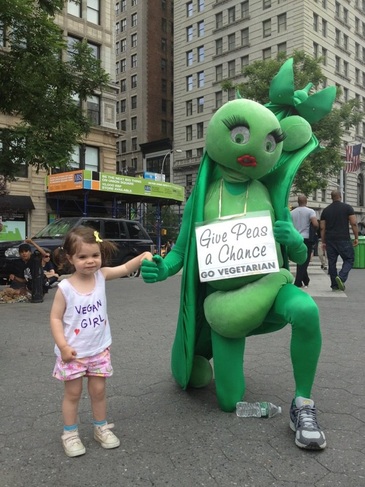
NYC Veggie Parade, 2012
Despite the many studies indicating that vegan diets are not only appropriate for children, but may in fact be healthier (for example, the American Dietetic Association—the nation’s largest group of nutrition professionals—stated, “Well-planned vegan diets are appropriate for individuals during all stages of the life cycle, including pregnancy, lactation, infancy, childhood, and adolescence, and for athletes”), parents are still opting to add animal products to their children’s diet, mainly as a result of tradition and being constantly bombarded with messages from the dairy and meat industries. Years of slogans like “Milk does the body good” and “You need meat for protein” have been drilled into our heads by multi-billion dollar industries pushing their products. If milk does the body so “good” then why is it that the countries that consume the most milk are also the countries with the highest rates of osteoporosis- and vice versa. And the more animal protein that a population consumes, the higher the prevalence of osteoporosis. There is a big protein myth out there, but the fact is Americans eat about 400% more protein than necessary, and even vegetarians eat more than they need.
It would be unethical for me to feed my child meat, dairy, or eggs based on what I know about how animals are raised for food. You can look the other way or deny that it’s as bad as they say, but the truth is, the majority of meat/dairy and eggs sold in this country (>95%) come from animals who have been raised in appalling conditions in overcrowded, filthy warehouses, where they are crammed into small cages and crates and denied basic necessities, including fresh air, sunshine, grass, and companionship. Simply put, I don’t believe that animals should be treated like this, so I’m choosing to leave cruel animal products out of my child’s diet. I’m teaching her that if she wants to help end animal suffering and also not knowingly contribute to major environmental problems including climate change, water and air pollution, deforestation, and soil erosion she has to be a part of the solution, and that means not supporting it (with dollars). This is what it really means to live according to your values.
It would be unethical for me to feed my child meat, dairy, or eggs based on what I know about how animals are raised for food. You can look the other way or deny that it’s as bad as they say, but the truth is, the majority of meat/dairy and eggs sold in this country (>95%) come from animals who have been raised in appalling conditions in overcrowded, filthy warehouses, where they are crammed into small cages and crates and denied basic necessities, including fresh air, sunshine, grass, and companionship. Simply put, I don’t believe that animals should be treated like this, so I’m choosing to leave cruel animal products out of my child’s diet. I’m teaching her that if she wants to help end animal suffering and also not knowingly contribute to major environmental problems including climate change, water and air pollution, deforestation, and soil erosion she has to be a part of the solution, and that means not supporting it (with dollars). This is what it really means to live according to your values.
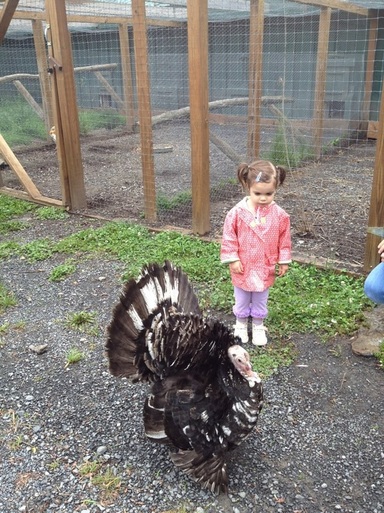
Catskill Animal Sanctuary
People raise their children according to their own set of morals and values. Just like a Buddhist wouldn’t raise her child Catholic and an environmentalist wouldn’t raise his child to be wasteful, I wouldn’t serve my child chicken fingers or ice cream. Children are little extensions of ourselves (at least until they’re old enough to make their own decisions). In our society, we typically do not allow children to make the decision to participate in anything that is morally questionable until they are of age. Since I consider the way that animals are raised for food in this country to be morally abhorrent, I therefore would not impose animal products upon my child and would not allow her to make that decision until she is old enough to think critically and understand the consequences.
So instead of focusing on what a vegan child is not getting (fat-laden, cholesterol-filled slabs of meat as well as milk, cheese, and eggs from miserable animals who’ve been raised in terrible conditions), let’s focus on what they are getting (a healthy balanced diet of fruits, vegetables, whole grains, beans, legumes, nuts, and seeds). And my daughter is getting a whole lot more than that including a moral compass based on compassion, justice, courage, and integrity. So if you’re raising a vegan child like I am, stop being on the defensive, and start embracing it! Be proud that you are living with intention and consciously choosing compassion over cruelty!"
So instead of focusing on what a vegan child is not getting (fat-laden, cholesterol-filled slabs of meat as well as milk, cheese, and eggs from miserable animals who’ve been raised in terrible conditions), let’s focus on what they are getting (a healthy balanced diet of fruits, vegetables, whole grains, beans, legumes, nuts, and seeds). And my daughter is getting a whole lot more than that including a moral compass based on compassion, justice, courage, and integrity. So if you’re raising a vegan child like I am, stop being on the defensive, and start embracing it! Be proud that you are living with intention and consciously choosing compassion over cruelty!"


 RSS Feed
