Read Ruby Roth's (author of That's Why We Don't Eat Animals) exclusive post for RaisingVegKids.com. She shares fantastic tips and advice for parents raising veg kids. This is a must-read for all veg parents!
Guest post by Ruby Roth, author of That's Why We Don't Eat Animals
Congratulations on raising vegan kids! You’re setting your offspring on the best path possible in this day and age. While the rest of the children in this country are getting fat, ornery, and cataleptic, brain-fried on string cheese and Big Macs (you know what I’m talking about, you’ve seen these people grown), you’re stacking your cards in your family’s favor for health, for animals, intelligence, and for the future of the planet. The thought makes my heart sing.
Guest post by Ruby Roth, author of That's Why We Don't Eat Animals
Congratulations on raising vegan kids! You’re setting your offspring on the best path possible in this day and age. While the rest of the children in this country are getting fat, ornery, and cataleptic, brain-fried on string cheese and Big Macs (you know what I’m talking about, you’ve seen these people grown), you’re stacking your cards in your family’s favor for health, for animals, intelligence, and for the future of the planet. The thought makes my heart sing.
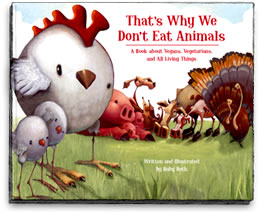
That's Why We Don't Eat Animals by Ruby Roth
Now, prepare for battle. Veganism, while most people have at least heard the word by now, is still new to the mainstream, so at many times, you and your family will be alone facing the firing squad at school, on the playground, at the doctor’s office. Whether they take aim with “Veganism is deprivation, practically child abuse” (Yes, I’ve actually been on the receiving end of this one) or “…but cows need to be milked to be healthy” (yep, this one, too) or “Oh, wow, that’s great! But you’ve got to watch out for calcium deficiency,” you will unavoidably hear a gamut of opinions from armies of the unaware and misinformed.
You’ll need ammunition, not only to respond in the moment, but to support your own commitment to veganism in the face of
challenges and keep a solid foundation of support for your child. The best ammunition is not only education but theory and insight beyond factual knowledge. Do memorize some facts and figures for your conversations with others. But when it comes to vegan longevity and supporting your kids in this lifestyle, it’s wildly more important to focus on creating a home environment
that values thinking outside the box; a home that has discussions, shares thoughts and opinions, and seeks new knowledge together. This kind of education lasts a lifetime and provides big-picture support even when you’re in the minority. Studying any and all subjects to support your lifestyle and teaching your children independent, critical thinking is key in a vegan household.
Parents, keep educating yourselves; make yourself your own authority figure so that you can decode and compete with the “expert" teachers, doctors, politicians, your neighbors (you can easily know as much as they do, and more!). Being well-read in a number of subjects including nutrition, healing, economics, civil rights, philosophy, religion, ancient civilizations, etc., will inform your veganism from all angles. Read things you agree with as well as opposing viewpoints. The more we uncover truths, the more knowledge we have in our arsenals, and the more we are“veganized” the more ammunition we amass to support
our path. We should always be reading. Pick a book in one area of the library and jump around from there.
Arming your kids is simple…and fun. Share what you learn. Expose them to different ideas and talk about them all. Make it a habit to initiate discussions when good opportunities arise. When you see a “happy” cow image on a milk carton, when you’re shopping for cruelty-free shampoo, when a McDonald’s commercial appears during Sesame Street, when you’re buying organic produce; talk about these moments and ask for your child’s help and participation. Ask questions, and find out their opinions and thoughts. Merely bringing up these subjects allows a child to think critically and formulate their own ideas outside the box.
Educating your family this way creates a strong support system and confident kids who are able to seek out information. More than their peers, your vegan children, even by first grade, will have had the space and opportunity to think through a number of ideas that most kids aren’t exposed to until they are in high school or college. They won’t be vegan simply because they mimicked you, but because they gained insight and knowledge about animals and our food systems at a young age. They will have learned to apply an independent, discerning eye to everything that comes their way in life. Congratulations…and thank you!
Ruby Roth is an artist and author living in Los Angeles. A vegan since 2003, Roth was teaching art in an after-school program when the children’s interest in healthy foods and veganism first inspired her to write That’s Why We Don’t Eat Animals. She has studied the emotional lives of animals, nutrition, and the health and environmental benefits of veganism and raw foods for seven years.


 RSS Feed
