Melissa Gates, Director of Programs at Catskill Animal Sanctuary shares her recent experience teaching kids, and tells us about the wonderful Camp Kindness vegan summer camp! It's a one-week long day camp run by trained humane educators that gives kids the opportunity to interact with farm animals, while inspiring them to make kind, compassionate choices for all. Check out this one-of-a-kind camp, and register your kids-- they will love it!


Guest Post by Melissa Gates, Director of Programs at Catskill Animal Sanctuary
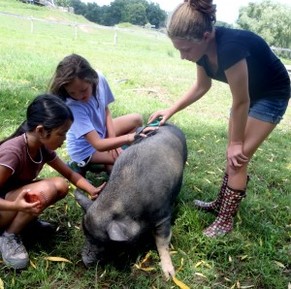
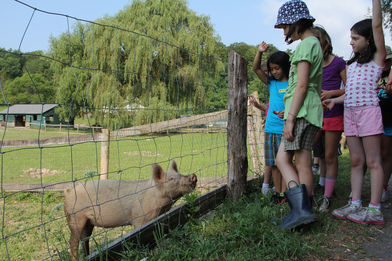
Ten Girl Scouts, ranging in age from nine to eleven years old, playfully traipsed after me in their sparkling new designer galoshes as I led them from Catskill Animal Sanctuary’s Welcome Hut around into the sloping potbellied pig field for their Volunteer Day.

“Are we going to scoop…pooooop?” asked one girl, her voice rising upward like a slide whistle accompanied by a face contorted into unspeakable crescendos.

“It would be very nice of us,” said I, raising a pitchfork to my side and motioning for the girls to circle around, “as these little loves depend upon CAS to provide them with proper affection, food, water and shelter. Part of that entails scooping up their poop every day.”

The potbellied pigs eyed the group of girls, snouts to the air and tails wagging, perhaps wondering if the day would bring treats or belly rubs or even better…both. This porcine crew knows the group volunteer gig pretty well. The shy pigs wander off to private corners, where they know we will respect their privacy. Suspicious pigs stand at a distance, smelling and rooting and planning and waiting. The extroverts wander over and introduce themselves with little nudges of their wet, sensitive noses against willing hands, legs and giggles. Shy Girl, who is, as her name implies, normally a quite timid resident at CAS, has days where she will waddle over to check out groups. Chopper, who eagerly falls over sideways at the mere suggestion of a hand heading toward his belly, can have shy days, too. Pigs, just like people and all other animals, have their moods. Today wasn’t one of those days for our friendly guy, Ozzie. He sauntered over, tail flailing a mile a minute with a clear look of warmth upon his face as his nose wiggled and pointed, smelling from girl to girl, likely anticipating his healthy dose of love and affection for the day, but not before…

One pointed finger became two then five then ten until a pitchy horror of shrieking girl chorus erupted,“EeeEEEEeeeeEEEw! He’s pooping NOW!”

At times like these, teaching moments choose us; those of us brave enough not to shy away from the challenge of poop discussions with little girls sporting designer galoshes in pink and yellow polka dots know what we must do. For those of us who make the conscious decision not to dilute the poop topic but rather to embrace the opportunity for heightened compassion, these moments are precious...even when faced with little girl squeals.

“Everybody poops, right?” I asked, looking around from surprised to disgusted to embarrassed faces. “This is Ozzie. He and other pigs are actually quite courteous when they go to the bathroom,” I continued. “When given the amount of space they need, pigs use one area for their bathroom breaks, another area for eating and yet another area for sleeping! What do you think would happen if our pig friends didn’t poop?”

“We wouldn’t have to pick it up!” exclaimed one child, affirming my theory that there really is at least one silly kid in every group.

“Hmmm. True,” I answered.“But how do you feel when you don’t go to the bathroom when you need to go?”

“Bad. My tummy aches and I feel bad if I hold it too long,” said another.

“Right; and we wouldn’t want our pig friends to feel that way, would we?” All the girls’ heads nodded no, emphatically. “Plus, what can most people do that pigs and other animals can’t, to our knowledge?”

“Excuse themselves to go to the bathroom!” hollered one girl, hand waving over her head. 
 
“That is a very astute point.” I replied. “There is something else humans can do that not many other animals can. What do you think that might be?” Hands shot up. I lifted a brow and extended an inviting hand to one girl who looked as though she might burst if she kept her answer in any longer.

“Ask their moms to drive cars to other bathrooms!” she sang out. Kids come out with the darndest things.

“Also a very good point,” I said. “So when you decide to excuse yourself or when you decideto ask your mom for help, rather than going to the bathroom on the floor, what is it you’re doing?”

“Deciding!” came a shout from one girl, who had really listened as I hung on the word decide.

“Exactly!” I encouraged,“Humans have the gift of intellect, which helps us make good decisions and come to correct conclusions about what is true or real and about how to solve problems. Other animals are smart and can learn human words and signs, and are very often effective at initiating communication and interaction with people. Animals have family units and friends; they think, feel love, suffer pain, and communicate with one another the same as we do...but in their own languages. They do not have the same level of advanced intellect that humans have, though, so in a human-powered world, this often puts animals in danger of being hurt, like if they were left out in fields full of their own poop, which would distress them and could also make them physically sick. This is one of the many kind ways in which people can take care of animals. We pick up their poop in the same way that we take care of our baby brothers’ and sisters’ poop when we help change their diapers.”

“Hey, why don’t pigs wear diapers?” asked the one quota-filling silly girl, with a practiced look of sincerity. I walked right into that one. 

The girls and I talked a little more about what it means to allow animals the dignity of their nature, to allow pigs to poop in their latrine area, to allow chickens to flap their wings, to allow cows to live free from milk machines, to allow the planet to live free from pollution, and to allow people the right to live free from wrongful discrimination. 

It wasn’t long before the girls were ambitiously scooping poop and satisfying Ozzie’s loving need for affection. They understood the good they were doing to help our pig friends, and with this newfound understanding and context of the help they were providing, the girls were happy to open their hearts to a stinky but necessary chore in order to lend a hand. The fires of compassion grew stronger in the girls’ hearts that day as their perspectives and experiences widened to include animals


I got to thinking, this really is the foundation for Catskill Animal Sanctuary’s Camp Kindness program, our vegan summer day camp for kids. At Camp Kindness, we offer kids opportunities for deciding to live with greater compassion. We provide facts about the impacts of animal-based agriculture on animals, people and the planet and we empower kids to think critically about
this wonderful world we share. Telling a child that he or she should be kind to animals is a nice start; teaching kids that they each have the power to lead lives based upon deciding to be nice to animals is a world-changing paradigm shifter.

At Camp Kindness, trained Humane Educators work closely with the small camp groups to empower each child to think freely, carefully and independently, and to arrive at their own conclusions and truths, as guided by the spirit of compassion for all. 

The age-appropriate lesson plans are mapped out well in advance of the four one-week long camp sessions, but each is molded like clay as it unfolds to meet the shifting needs of the individual kids and to positively reflect the group dynamic in order to bring out the best in each child. 

Kids are encouraged to think critically about food production issues, animal rights, the environment and their own health at Camp Kindness. One-on-one interaction with our animal friends is a key aspect of camp, enabling kids to learn about animal behavior and personalities as well as animal care. 

Kids leave camp understanding that every animal is a unique individual, which helps those who do not otherwise have an opportunity to mingle with traditionally farmed animals. Everyone leaves feeling supported and knowing that they are not alone; that feeling compassion for animals is indeed a wonderful and inspiring thing.

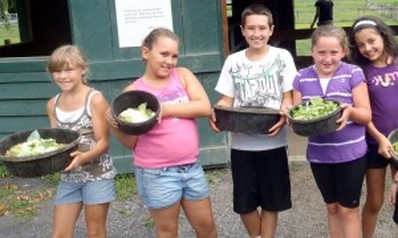
At Camp Kindness, kids are presented with facts and asked to think creatively and compassionately, and they leave with plenty of tools from which to choose, from vegan cooking skills and recipes to journaling for expressing feelings to growing their own food and gaining experience with animals and getting to know the personalities of a few critters. Camp Kindness helps to reinforce what compassionate parents teach their children every day; that all animals are thinking, breathing, feeling beings worthy of our love and respect; that we may each positively impact the world by deciding to make compassionate choices; that being kind to one another, to animals and to the planet feels good!

I left CAS at the end of this Girl Scout Volunteer Day feeling a strong sense of hope for the future and really looking forward to this year’s Camp Kindness sessions. If we can encourage little girls in glittering galoshes to set aside their dislike of poop in order to lend a hand to pigs in need, we can do just about anything, including making the world a more compassionate place...one child at a time.


To learn more about Camp Kindness or register your child for a session, click here:

To learn more about other CAS programming this season, including the weekend-long Vegan Parenting Workshop in July, click here.


Melissa Gates has directed two statewide animal rights organizations and is currently serving as the Director of Programs at the Catskill Animal Sanctuary in Saugerties, New York. She is a longtime vegan  and community organizer for animals, people, and the planet, with nearly  two decades of experience in the field. When not engrossed in her work, Melissa can often be seen out & about advocating for justice, hiking, exploring New York's live  music scene or snuggling up by her fireplace with some great jazz, a  good book & feline friends Eden-Shade, Mama Shed, Sumo Monster, Cito Mosquito Fernandez Jones & Levon Whitey Gates. 
 
 
Guest Post by Jessica Almy, creator of Vegbooks.org

Jonathan Safran Foer wrote in his new book, Eating Animals that we should rethink our traditions surrounding food. To honor the Thanksgiving holiday, for example, Foer urged his readers to focus on harvest foods that reflect what we understand to be “good food” food whose“ingredients, setting, and consuming are expressions of the best of us.” And after following Foer into slaughterhouses and factory farms, most readers would join him in concluding that “good food” is more likely to be plant-based than animal in origin.

Until Foer’s ideas about how to honor our traditions and the values that we hold are widely shared, however, many vegans have a hard time finding comfort in a culture that celebrates the confinement, slaughter, and consumption of animals. The flesh and secretions of animals are standard fare on any menu. Jokes about Tofurkys abound. And here in Washington, D.C., we have a lame tradition of pardoning a single turkey at the White House as if it’s the turkeys who’ve done something wrong.

Imagine then what it’s like for vegan kids. Many have never consumed an animal themselves, and even on the best of days, the kids and adults in the school cafeteria don’t look kindly on meatless deli slices and soy yogurt. Teachers expect them to know the likes of Ronald McDonald and Chuck E. Cheese. And then there’s the blatant untruth portrayed in the vast majority of children’s books that depict farmed animals. A sunny day on Old MacDonald’s Farm somehow supplants the concentrated animal feeding operations that pervade contemporary animal agriculture, with nary a mention of overcrowding, debeaking, prophylactic antibiotics, the “disposal” of male chicks and calves, or manure lagoons.

That’s why I believe it’s so important to celebrate vegan books for kids or those (like Sweet Chili Doritos) that are “accidentally vegan.” Kids deserve to see themselves and their values depicted in the literature they read. And as our culture shifts subtly to embrace improved animal welfare standards, environmental preservation, and the incorporation of locally grown fruits and
vegetables into every meal, all children benefit from “vegan” kids books, by which I mean books that support vegetarian and vegan values, including animal welfare or rights, environmental protection, and healthy food choices.

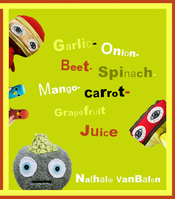
Among my favorite vegan books are That’s Why We Don’t Eat Animals by Ruby Roth, Garlic-Onion-Beet-Spinach-Mango-Carrot-Grapefruit Juice by Nathalie VanBalen, To Market, To Market by Anne Miranda, and the familiar Horton Hears a Who by Dr. Seuss.
 

These books aren’t just good books in a literary sense– they’re also good books. Books that encourage children to rethink their assumptions, to see animals for who they really are, and to stand up for the defenseless. The kind of books that will help prepare children to be leaders in one of the most important social justice issues of our time– the rights and welfare of nonhuman animals.

While discerning parents and teachers can certainly find these books, and others like them, they still represent a tiny, tiny minority of the books that are marketed to children. In fact, I’d be willing to bet there are ten or twenty times more “happy farm” books on your library shelves than vegan-oriented kids books.

Just as we vote with our dollars when we buy food, so too can we send a powerful message to booksellers, publishers, and authors when we buy books for our children. Next time you plan to go to the book store, bring a list of veg-friendly titles along
and ask for them. Ask your librarian to purchase some of your favorite titles for the library shelves. Host a veg-story time at a local cafeé. And when the grandparents ask what your child needs at the holidays or her birthday, have a few titles handy.

Together, we can raise children who value life, the connections between humans and other animals, and the need to protect the earth and all its inhabitants –and perhaps we can even spread messages of kindness and compassion beyond our families into our communities.

A vegan, mom, and avid reader, Jessica Almy lives in Washington, DC with her husband, their six-year-old daughter, and their cat Cassie. She is the creator of Vegbooks, a site that reviews kids books and movies from a vegetarian perspective.