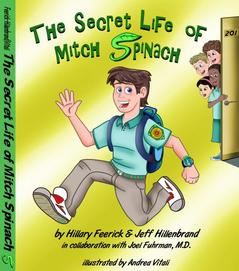
The authors of The Secret Life of Mitch Spinach give us 10 easy suggestions for encouraging kids to eat more fruits and veggies. A lot of good tips. Read and share with other parents!

So, what else can you do when your child refuses to eat anything green and seems to subsist on chicken-fingers and French fries alone? 

1)    Educate your kids about nutrition.The more they know the easier it will be to guide them into making good choices. Remember how smart kids really are. Don’t sell them short. If they enjoy sports, are interested in beauty, or want more energy, teach them how the foods they eat will help them do what matters to them most. 

2)    Make food preparation a family affair.The more you involve your kids in the preparation and selection of meals and snacks, the more willing they are to try healthy foods. Even a simple trip to the grocery store to allow them to pick out the fruits and vegetables for the week (each child in the family should get his/her own choice) can make a world of difference. Let older children find recipes online that sound good to them using healthy foods. Allow them to choose how the vegetable of the day is prepared and even help in the preparation.  

3)    Have a make-your-own smoothie party. Fill bowls with various ingredients, such as berries, mango, spinach, broccoli, flax or chia seeds, and let kids pick what they want. They can even turn the blender on! They love to be in control!

4)    Make your own salad. The same trick will work for salads. But don’t just include lettuce. Use seeds, fruit, dried peas, anything goes!

5)    Let them dip. Make a dip like hummus or use a healthy store-bought version and watch them eat string beans, carrots, celery, cucumbers, and any other veggie that you cut into strips for dipping. 

6)    Make veggie and fruit shapes. Thinly slice carrots and cucumbers and use tiny cookie cutters to make shapes. Everything is more fun when it’s in a shape (think silly bands).

7)    Make a vegetarian soup at least one night of the week. Pureed soups are great because you can’t see what’s in them (kale is easy to use this way). You’ll be amazed what they’ll eat when it’s been whizzed in the blender or  mixed with an immersion blender.

8)    Remember that food preferences are formed by one’s environment and taste is a learned phenomenon. In fact, studies show it take 8-15 times before a child accepts a new food. Try a different way of preparing the same food. Once you find a way that your child likes that food, you can branch out and experiment with it because their taste buds have already adjusted to it. Food preferences and tastes are formed early in life, so it is important to introduce your children to a variety of fruits, vegetables, and whole grains.

9)    Don't make excuses. Don't say, "My kid only eats chicken fingers." He/she is not purchasing those chicken fingers with his/her allowance. You make the rules in your house. You purchase the food. Don't buy the junk! Kids are born with survival instincts. They will not starve themselves. True hunger is difficult to deny, and when children are faced only with healthy food options their natural hunger will drive them to eat the healthy foods available, without bribing, coercing or any other schemes. Scientific research shows that children most often take on the eating habits of their parents. Once they realize that there are no other options, they will eat, and then they will begin to change their habits. So will you. 

10)    Lead by example. If you permit only healthy foods in the house the entire family will learn to eat properly. You can't tell your children to eat broccoli while you are eating French fries. You must show them how to eat by doing it yourself. The entire family needs to eat the same foods at mealtime. The food that is being served is the only option. Include a number of choices so that children maintain some feeling of autonomy in what they eat, but NEVER make a separate kids’ meal or allow them to order off of the kids’ menus at a restaurant. Mealtime is a communal, family time to come together. Let that attitude be reflected in the sharing of the meal. Kids’ menus are rife with terrible food. Stay away from them an order from the sides for your kids or share what you order (the portions are usually too big for one adult anyway).


--------------------------------------------------------------------------------------------------------------------------------------------------------------------------

 
The Secret Life of Mitch Spinach was written in collaboration with renowned, board-certified family physician, Joel Fuhrman, M.D., who specializes in preventing and reversing disease through nutritional and natural methods.


To get kids on the right track with healthy eating, order the Mitch Spinach book series at www.Mitchspinach.com 


BIO:
Frustrated by the lack of a healthy, smart, cool role model for their five and six year-old children, Hillary Feerick and Jeff Hillenbrand created the Mitch Spinach children’s book series. They decided to combine their expertise (Jeff holds a BS in Exercise Physiology, and  Hillary holds a BA and MA in English) to teach kids about the importance of eating healthy foods and reduce the number of children struggling with weight, chronic colds, ear infections and other nutrition-related problems. 

 
 
Authors Hillary Feerick and Jeff Hillenbrand share some very valuable insight into what our kids our eating nowadays, and the harm it is doing to their health. They wrote The Secret Life of Mitch Spinach, to encourage and inspire kids to eat more fruits and vegetables. This is an important post for parents, teachers, and anyone else concerned about the future health of our children. Please read on!

Guest Post by Hillary Feerick and Jeff Hillenbrand
As parents, we want what is best for our children. We take the role of protecting them very seriously, and we would never intentionally harm them. We read to them at bedtime, provide them with the best education, insist that they wear their seatbelts, but when it comes to food, somehow many of us falter. In this country, however, we have failed so significantly to nourish our children that the CDC (Centers for Disease Control and Prevention) has predicted that this is the first generation of children that may NOT outlive their parents. The latest scientific research has shown that the foods our children eat in the first 10 years of their lives has a critical and profound effect on their lifelong health, but we have not fully comprehended the gravity of these findings. As a result, the number of obese and overweight children has tripled in the last thirty years, and the number of cases of type 2 diabetes (a disease once called “adult onset diabetes” and linked to high sugar intake) has increased at an alarming rate. And the list of frightening statistics goes on: The results reported by the 1992 Bogalusa Heart Study confirmed that most children and teenagers already had significant plaque buildup in their arteries (a precursor to heart disease). American children consume less than 2% of their diet from fruits and vegetables. About 25% of toddlers between ages one and two eat no fruits and vegetables at all. By the time American children are 15 months old, French fries have become their most commonly consumed vegetable. They move into adulthood eating 90% of their calories from dairy products, white flour, sugar, and oil.


While we have educated our children about the dangers of smoking cigarettes and the use of recreational drugs, we just don’t realize how damaging eating foods on the kids’ menu really is. In fact, The World Health Organization (WHO) has recently stated that more people die today from eating a diet full of junk and processed foods than from cigarette and illegal drug use combined. We wouldn’t allow our children to sit at the table, smoking cigarettes and drinking whisky, but we don’t think twice about regularly giving them candy, soda, fries and cheeseburgers, foods that are shockingly more harmful. Although we would never mean to do anything to hurt our children, every day we are unknowingly causing significant harm.

This heavy emphasis on candy, junk food, and other forms of junk foods does not help our children reach their potential. In fact, a recent study published in The Journal of Epidemiology and Community Health suggests that it limits their brain development. The study followed the dietary patterns of nearly 4,000 children from birth for over eight years and found that toddlers who ate a nutrient-rich diet full of fruits and vegetables had higher IQ scores when they reached 8 years of age compared to the toddlers who consumed processed foods full of fat and sugar.

In response to the current health crisis in America, many counties and states have written laws that prohibit parents and teachers from serving foods or beverages whose first ingredient is sugar. (Please see attached example of New Jersey's policy.) Some states, school boards, and individual schools have implemented additional limits on trans fats and prohibit candy and sugared beverages in any form. The Broward County Schools Wellness Policy (the county in which we live and our children attend elementary school) states that “Schools shall encourage fundraisers that promote positive health habits such as the sale of non-food and nutritious food items as well as fundraising to support physical activities.” Michelle Obama has launched the Let’s Move Campaign to get kids exercising and making healthier choices.


These are all steps in the right direction. However, as parents of a first-grader and a Kindergartener, we know first-hand how difficult it really is to raise healthy kids in a fast-food and junk-food filled world. Adults know that good nutrition fosters academic and athletic performance, but getting children to understand the importance of a healthy diet can be a daunting task. Children need fun and entertaining ways to learn about healthy eating. Many parents recognize the problem but find it difficult to implement change. Frustrated by the lack of a healthy, smart, cool role model for our 5 and 6 years old children, we created a super hero who gains powers from fruits and vegetables: Mitch SpinachWhen children read about his adventures, THEY ask YOU for fruits and vegetables. The subtlety of fiction enables children to learn without even realizing that they are learning.


In the first book in the series, The Secret Life of Mitch Spinach: 
  
Mitch Spinach seems to be an ordinary kid, but his classmates have begun to suspect something. The notes in his custom-made, temperature-controlled Nutripak-lunchbox appear to have been written in code. While other kids eat their usual   chicken fingers and pepperoni pizza, Mitch Spinach mixes up his meal in a battery-powered blender before their curious and envious eyes. Although he is the smartest, nicest, strongest kid in Ms. Radicchio’s class, he often misses recess when he is called to Principal Lycopene’s office. The truth is that his high- powered fruit and vegetable smoothies give him special powers, such as super-sonic hearing and amazing night vision, which help him tackle problems and solve mysteries at Sunchoke Elementary.

Written in collaboration with renowned family physician and best selling author Joel Fuhrman, M.D, The Secret Life of Mitch Spinach provides a perfect way for kids to learn about healthy eating while enjoying exciting  adventures and mysteries. Each book in the series contains a healthy recipe and a “Secrets for Parents and Teachers”section, written by Dr. Fuhrman, that explains many of the nutritional concepts alluded to in the book. Dr. Fuhrman is a board-certified family physician, author, and nutritional researcher who specializes in preventing and reversing disease through nutritional and natural methods. 
 
While many books focus on a child’s dislike of a certain food (usually a vegetable), this book series is devoid of that type of negativity and instead transforms healthy eating into a behavior to be copied in order to gain “super” powers like those of Mitch Spinach. The Mitch Spinach children’s book series has the power to significantly change the way that children eat because it actually prompts children to ask for healthy food without preaching to them about the benefits of a healthy diet. 
 
The Mitch Spinach
website features creative, multidisciplinary lesson plans and outlines the importance of sound nutrition. Kids can print educational games, such as crossword puzzles and word searches that pertain to the healthy foods used in the books to reinforce what they have learned.

A new resource to help you in your quest to adopt a healthy lifestyle as a family, the Mitch Spinach book series can make your transition even easier. When kids start asking their parents for broccoli, carrots, or flax seeds because they want to be like Mitch Spinach, your own healthy choices will seem effortless and fun!

To get kids on the right track with healthy eating, order your copy of The Secret Life of Mitch Spinach and the brand new
Mitch Spinach and the Smell of Victory by visiting the website.

Stay tuned for Part II: 
10 Secrets to Get Your Kids to Eat More Fruits and Veggies


Editor's Note: A big thank you to the authors for addressing such a timely issue, and working to fix the problem by creating a tool for parents (and teachers) to use to encourage kids to eat their fruits and vegetables. I highly recommend this wonderful book. Check out my review on
VegbooksHere is a printable memory card game that features fruits and vegetables.


Hillary Feerick and Jeff Hillenbrand have been married for 15 years and have two young children, a girl and a boy. Months before their first child was born, they began to delve more deeply into infant and maternal nutrition. Compelled by the difficulties of raising healthy children in a fast-paced, junk-food-filled world, they decided to combine their expertise in health (Jeff holds a BS in exercise science) and writing (Hillary holds a BA and MA in English and is an English teacher) to create Mitch Spinach, a healthy role model for children.