Looking for vegan food, personal care products, household cleaners, and more? Then read this next post! Vegan dad, Jeff Repanich, founded the Vegan Product Guide-- a database that includes a long list of products from A-Z which are all color-coded as vegan, not vegan, or debatable. This is a great resource to share with your friends and family!
Guest post by Jeff Repanich, founder of Vegan Product Guide. Finding vegan shampoos and baby bath used to be arduous. We’d surf the web until we found a list of products that weren’t tested on animals, then hit a discussion forum to find some chatter about whether they were vegan. Often, we’d double-check the ingredients from the manufacturer’s website with a list of ingredients derived from animals. And then we’d go to the store …sometimes only to find out that the product we’d decided on was out of stock. I knew there was a better way. We always found out about the good stuff from our vegan friends. The problem was, no one ever wrote it all down. And, I thought, wouldn’t it be even better if we had the opinions of even more vegans?
I launched the Vegan Product Guide to make information about great vegan products more accessible.
The Vegan Product Guide is a user-driven database that allows users to vote on whether a product is vegan, leave comments, and make shopping lists. Whether your family is new to veganism, you’re simply trying to live a more plant-based lifestyle, or you’re veteran vegans with friends and family that aren’t so good at reading labels, the Guide is for you.
To get started, create an account. This will allow you to vote on products, leave comments, add tags, and make your own shopping list. Next, search for your favorite products if you want to leave feedback to help other vegan families or look for new foods, personal care products, fashion accessories, or home cleaning products by browsing the site or using the search box. Are your children’s teachers befuddled by what snacks are appropriate? You can direct them to the Vegan Product Guide and have them search for “green” products, which have been voted to be genuine vegan. Have a relative or friend who isn’t so good at reading labels? Create a shopping list of holiday candies, or favorite snacks, and print out a copy next time you visit.
The Vegan Product Guide is intended to make following a vegan lifestyle fun and easy. I hope you’ll join us and share your favorite vegan products.
Jeff Repanich is the vegan dad behind Vegan Product Guide. Ever since he built his first website to share a vegan waffle recipe, he has enjoyed web development. He makes outrageously delicious Swedish pancakes and is prone to add Daiya cheese to just about everything else.
Celeste Hill is an organizer of Vegkins, a Minnesota-based vegetarian and vegan families group. In this post, she shares her insight on the importance of getting together with other parents who are raising vegetarian or vegan kids. Parents can share recipes and ideas, and offer advice and support to one another, and kids can participate in animal-friendly events, and simply play with other kids who share their same lifestyle. So seek out other veg parents in your community today!
Guest post by Celeste Hill, organizer of Vegkins Way back before Vegkins came into existence, my husband and I lost touch with the vegan community. There was no Facebook back then. Hard to imagine I know.
Once our son was born, we became cognizant of this missing part of our life. Having children has a way of bringing your beliefs, whatever they may be, into sharp focus. Thus began our search for fellow vegan parents.
After meeting a few local vegan families like the one from These Little Piggies Have Tofu, we were lucky enough to run into Dallas Rising from the Animal Rights Coalition (ARC). She was collecting names to start a vegan/vegetarian family group. We were simply ecstatic. It is all history from there. Vegkins is a program of ARC, for parent(s) of vegan and vegetarian kids. It meets on a monthly basis within the twin cities of Minneapolis and St. Paul. The activities include story hours, playground play dates, holiday parties, vegan soft serve meet-ups, a visit to a no-kill animal shelter, waffle parties, puppet shows, music classes and potlucks.
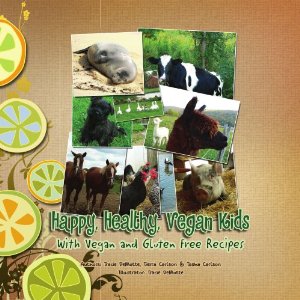
As a parent, I've found it endlessly helpful to provide my children with a supportive vegan/vegetarian family community. What kid wouldn't enjoy a vegan Halloween party or a waffle party? What you can't see on a web site or fan page are the friendships which have blossomed from ARC's Vegkins. Many families attend each other's birthday parties and get together socially outside of Vegkins. Frankly I can't tell you how much it means to our kids to interact with vegan peers. The supportive nature of the group has been amazing. We share advice on handling difficult situations, school activities, as well as recommend books and movies to each other. Each year, more families join our group and find that niche they've been seeking. It is an integral part of helping our children maintain their veg lifestyle, as well as normalize it. They know other kids out there who are thriving, as they are too. Lastly, I'll end with a book recommendation, which my young kids love. It is called Happy, Healthy, Vegan Kids. There are beautiful pictures of rescued farm animals living happy and peaceful lives at sanctuaries. My kids are apt listeners when we read this story. It also contains some simple veg recipes. We appreciate the focus on positive pictures since the kids are still young. Editor’s Note: As Celeste mentions above, it is really important for vegetarian, and especially vegan parents to meet other parents who are also raising veg kids. You can learn so much from eachother, and kids can meet and play with other kids who share a similar core value. Check your local community to see if a veg group already exists (if you live in the Minneapolis/St. Paul area, join Vegkins, and if you live in the NYC area, join NYC Vegetarian and Vegan Families Meetup) and if not, start your own! Make flyers, run an ad in the newspaper, coordinate it through your child’s school or day care center, or approach a local veg restaurant for help getting the word out. Read my “Start a Group For Vegan Parents and Kids In Your City” blog post on Girlie Girl Army for some inspiration.
Celeste Hill has been vegan for more than a decade and is the proud mother of two vegan kids, as well as an assistant early childhood family education teacher. She has a serious cookbook collection addiction, in fact she won the VegNews Holiday Cookie contest, so definitely check out some of the recipes on her website, Growing Up Veg--a wonderful resource for vegan parents.
In this post, Kathy Stevens, director and founder of Catskill Animal Sanctuary (CAS) tells us why it's so important for kids to meet farm animals. She encourages families to come visit the cows, pigs, horses, chickens, rabbits, turkeys and goats living at the sanctuary. If you are raising your kids vegetarian or vegan, visiting CAS is a must. Starting in March they will have accomodations on site, so you can stay right at the sanctuary!
Guest post by Kathy Stevens, founder and director of Catskill Animal Sanctuary
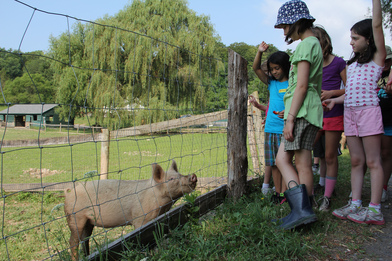
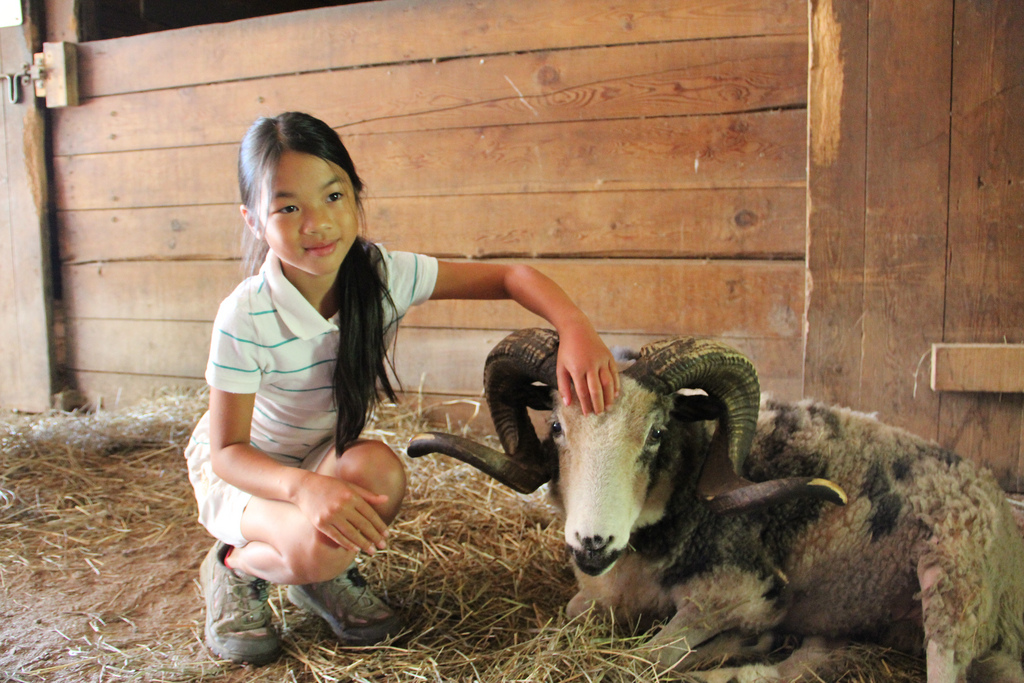
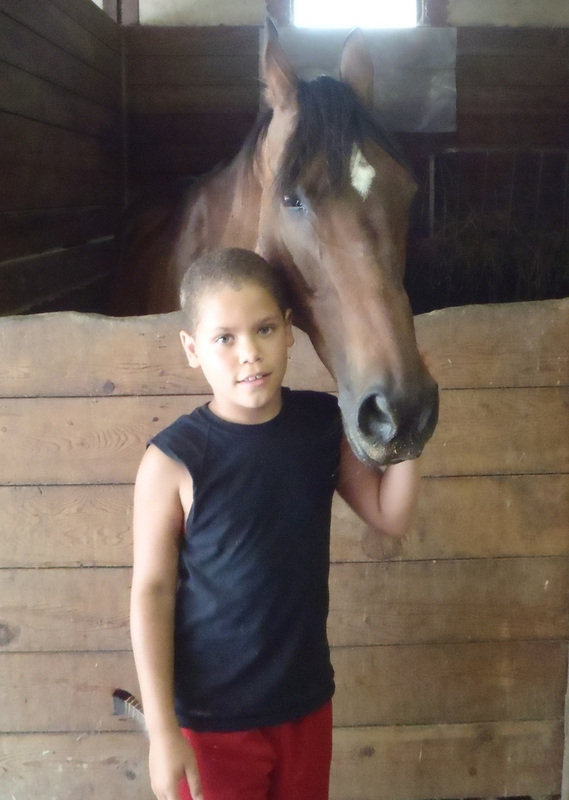
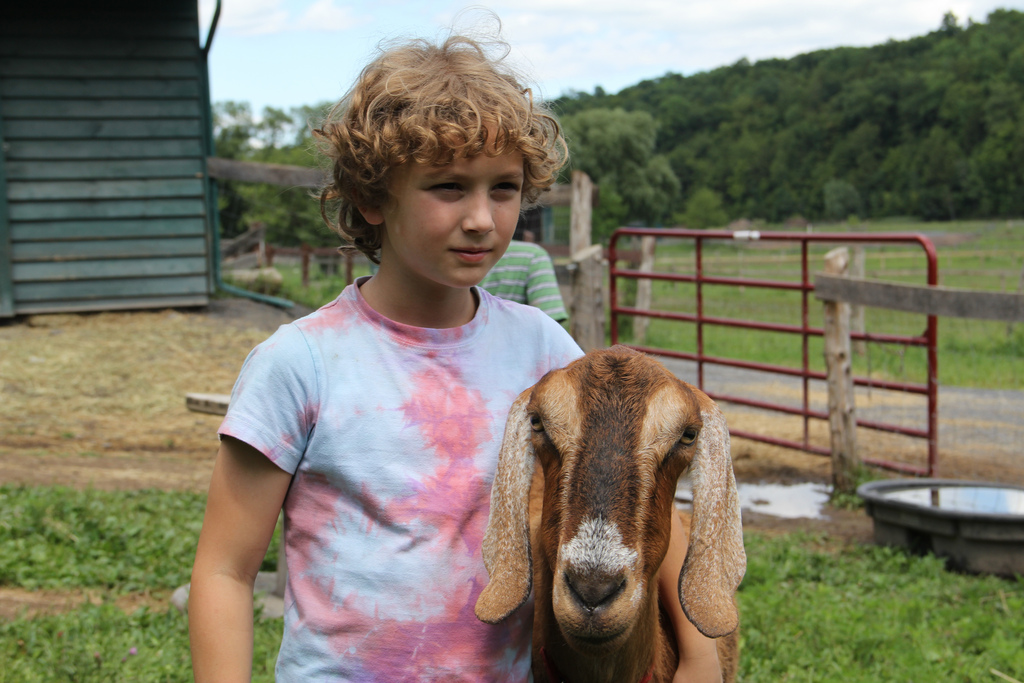
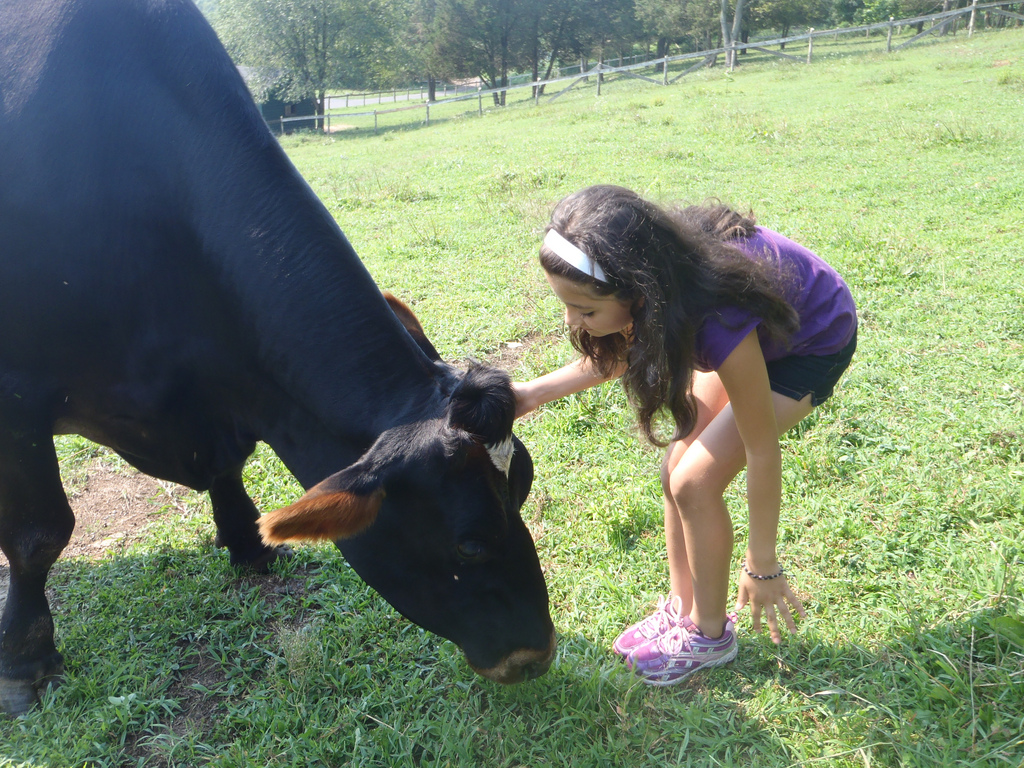
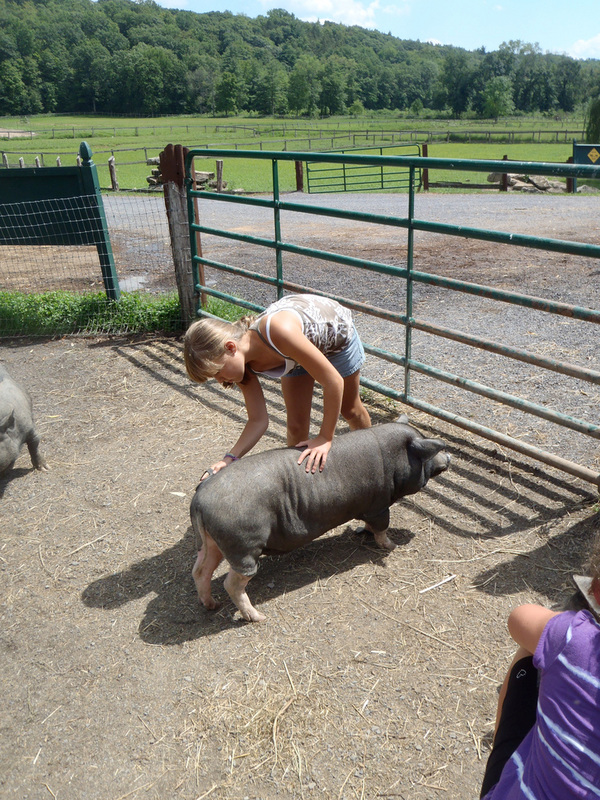
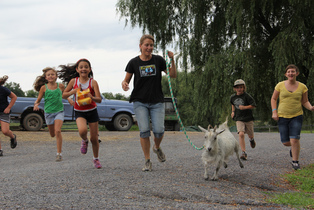
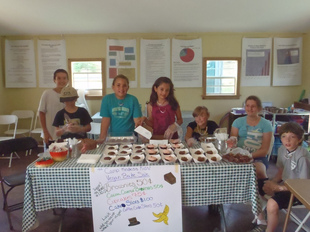
It’s seven in the morning. Kathy Keefe, Catskill Animal Sanctuary’s (CAS) farm manager, is stacking dishes on a cart inside the main barn’s spacious feed room. The pig dishes are piled and overflowing with broccoli, apples, tomatoes, beans, and pumpkin; the horse dishes are each different from the other, depending on the nutritional needs of the Sanctuary’s resident equines, and the same is true for the chicken dishes. Heavy broiler chickens who struggle under industry-induced obesity get a low-calorie diet, while others get calorie-dense sunflower seeds and cracked corn mixed in with their grain-based diet. All the chickens get leafy greens, too, and even the broilers get to snack on an occasional grape or banana slice. One dish gets glucosamine, another an iron supplement, electrolytes in a third and Omega 3’s in a fourth. That’s the level of individual care the animals at Catskill Animal Sanctuary receive. The notion that whether human or hen, we are all individuals and should be treated as such permeates every aspect of CAS, and I believe it’s the main reason families flock to us. When you bring your kids to CAS, for instance, you’ll find that there’s no such thing as a “standard tour” at our 110-acre farm animal sanctuary. Instead, your family is apt to be greeted in the parking lot by a member of the Underfoot Family-- a pig or chicken, turkey or goat who, for one reason or another, is happier roaming freely than living among members of his/her species. So be forewarned, a human may well walk out to greet you, but so might Rambo the sheep, Mike the rooster,or Arthur the goat. Next, you’ll find that your tour guide will want to know the names of your children, how old they are, and whether they’ve ever kissed a pig or napped with a cow. There’s no “script” at CAS, so I can’t promise that these will be the exact questions; but what I can promise is this: that from the moment you arrive, your child will be actively included in the experience of visiting Catskill Animal Sanctuary. In fact, when tour groups are filled with families with young children, they often don’t move too far and definitely don’t move too fast. Why? Because kids need to sit on the ground, eye to eye, with Ethel the turkey. Because kids need to walk slowly into the rabbit enclosure and sit quietly (“Pretend to be a rock,” we say) as the shy creatures inch closer, perhaps sniffing a knee, before hopping away. And because kids need to lie on their bellies, heads in their hands, watching the pigs do what pigs do: root, flop down in the pond on a hot day, press their cool wet snouts through the fence to say hello. When you’re raising vegetarian/vegan kids, or moving along that path, visiting places where food animals are happy and right there, in your face, reinforces all that you’re doing at home. When children have had the chance to be kissed by a cow, choosing a different meal simply affirms their innate kindness and deepens their bond with our animal friends. We recently received an e-mail from a proud mom. Her son Henry, now ten years old, has attended our children’s day camp, Camp Kindness, for two summers in a row, and has since become a passionate and committed vegan. Henry and his family were recently out at dinner with family friends, and Henry was questioned by the grown-ups about his diet. According to his mom, after very eloquently listing several animal, health, and environmental reasons for his decision, Henry looked at the grown-ups and said, “So I think that the question shouldn’t be about why I’m vegetarian…the question should be about why you aren’t.” Camp Kindness vegan bake sale Come share the love. Catskill Animal Sanctuary in Saugerties, NY is open for tours Saturdays and Sundays April through October. The Homestead, our four-room inn, will be open year-round, seven days a week, beginning in March so you can plan your trip and stay right at the farm! Camp Kindness, which holds week-long sessions in July and August, will begin registering children in April. We hope to see you soon! Note from Editor: My husband and I visited CAS a few years before our daughter, Charlotte was born, and can attest to the fact that it is truly a beautiful haven for rescued farm animals. The animals who live there receive so much love and attention. We can't wait to bring Charlotte this summer! The sanctuary is located within 1/2hr of the historic town of Woodstock. So make a family vacation out of it; visit the sanctuary (sleep on site), go hiking, go tubing down the Esopus River, take a train ride on the Catskill Mountain Railroad, shop, and eat at one of the many vegetarian restaurants in the area. Kathy Stevens is the Founder and Director of CAS. Kathy moved to Boston for graduate school, and after a decade of teaching high school English, she was asked to head a charter school. Instead, one year later, she opened Catskill Animal Sanctuary, one of the country's leading havens for farm animals and a center for raising public awareness of their sentience and their suffering. She is the author of two critically and popularly-acclaimed books, "Where the Blind Horse Sings" and "Animal Camp", a regular blogger on farm animal issues for the Huffington Post, and a frequent contributor to books and articles on farm animals, vegan living, and related issues.
Elizabeth Forel, president of The Coalition to Ban Horse Drawn Carriages is leading the fight to shut down the horse-drawn carriage industry in NYC. Read her post below to find out how you can help get these sweet horses off the streets...
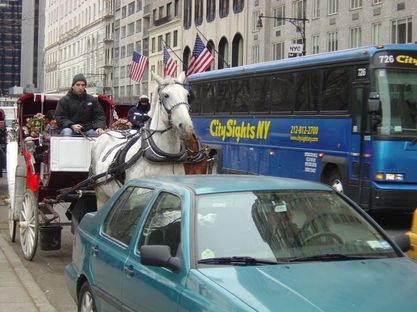
photo by Elizabeth Forel _ Guest post by Elizabeth Forel If you live in New York City, most likely your exposure to horses is to the “famous” NYC carriage horse.They are famed more for being a contrived icon, reflecting past times when people did not think so much about how the animal felt but rather how they felt as they fantasized they were one of the wealthy riding in a horse-drawn carriage -- maybe riding on a snowy night. How lovely and romantic … but not for the horse. Times are different now, and there is no need for horses to pull people around, especially in one of the busiest cities on the planet.
Many people are much more aware of animal cruelty and suffering nowadays and do not want to be a part of it. Carriage horses never have a nice day. They do not have the option of saying yes or no.Pulling tourists is their job - a job that was forced on them. As prey animals they are conditioned to protect themselves against potential threats - real or perceived - and to react quickly. That is why we often hear of horses spooking and bolting into traffic to get away from their source of fear, which can be a loud noise or even a rustling leaf. They are massive in size and strength, and as they gallop down a congested street they can cause injury and death to themselves and others.
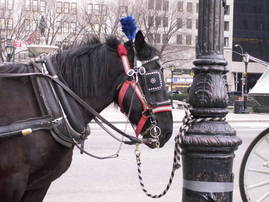
Horses don't belong on loud, busy city streets. (photo by Donny Moss) _ Working tightly restrained between the shafts of the carriage and wearing blinders, horses are denied their most basic instincts, even the ability to scratch an itch. By law, they may work nine hours a day, seven days a week. They are supposed to get a 15- minute break every two hours but this law is not enforced.
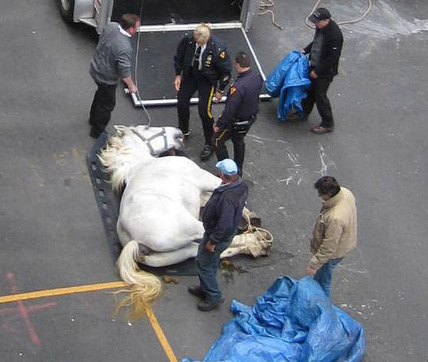
During the holiday season, the horses are worked till they drop from exhaustion as one did on December 4th on 59th St. This was the fourth in a series of incidents that began on October 23rd with the death of Charlie Horse who collapsed and died on West 54th Street (pictured below right). Charlie's death was followed a week later by a horse who spooked and bolted onto Central Park South, running scared through traffic until he finally crashed his carriage on Seventh Avenue. On November 4th, a horse named Luke collapsed on West 60th Street. This slew of recent incidents has brought needed attention to the cruelty in the carriage-horse industry, and more support for a ban.
Charlie collapsed and died on West 54th Street (photo by Matthew Miller) _
Horses forced to pull carriages have a rough, miserable life. After pulling heavy carriages for hours on end in all weather extremes the horses go back to their stables on the far west side of Manhattan-- there are four stables. Their stalls are generally on the 2nd floor, accessed by a very steep ramp. The minimum stall size by law is only 60 sq. ft. which is less than half of what experts recommend, which is 144 sq. ft for standardbreds and 196 sq. ft. for the larger draft breeds. This is barely enough room to lay down. For these poor horses, there is no pasture to graze in the grass.The next day, they are pulled out of the stables and put on the job again -- wearing blinders and heavy tack, between the shafts of their carriages. This is truly a miserable existence.
There are many alternatives to riding in a horse-drawn carriage in Central Park in NYC. Depending on the season, consider walking through the beautiful park, renting a bike, having a picnic, renting a boat at the Boathouse, or going ice skating on Wollman Rink (or just watching the skaters). If you want an interesting, fun ride around the park and city, consider taking a pedicab ride.This is an open rickshaw type vehicle, pedal driven by the driver.The people who drive these vehicles choose to do this work unlike the carriage horses. So choose an activity that you and your family can be proud of, one that doesn't involve animal cruelty.
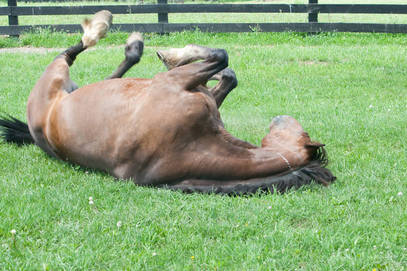
_ There are two animal sanctuaries, both about two to three hours outside of New York City, that are a must see. If you have kids, take them, they will love it! Many rescued horses live out there lives in peace, comfort and are treated with love and respect at the sanctuaries. 1) Equine Advocates in Chatham, NY has about 80 equines, which include some adorable donkeys, a couple of grumpy Llamas, pygmy goats and a host of horses rescued from all kinds of horrible situations. Some worked in the Premarin industry where their urine was used to make hormone drugs for women. Others came directly from the kill auctions, break downs from the racetrack. These animals now get to live out their lives in a natural, safe environment allowing them to socialize with each other, something so necessary for herd animals as horses are. 2) Catskill Animal Sanctuary is the other heaven on earth in Saugerties, NY. They have several horses at Catskill, but you can also meet pigs, goats, sheep, chickens -- and you can do a farm tour with president, Kathy Stevens. They also host many fun events throughout the year so check the calendar! Check with both organizations first before going there since they close during certain seasons. But it is absolutely worth the trip. Kids will love it and they get it.They are introduced to animals in a natural environment and the respect and understanding comes naturally. It is hard to learn respect for animals when one sees them in bondage in such cruel conditions. They appear like automatons with little expression or spirit. They are commodities used to make money. Most of the driver/owners consider the horses beasts of burden with no needs or desires of their own. To them, they are just “work horses” - a means to an end. But in a natural supportive environment, these horses will blossom. ..as evidenced by the picture below. Bobby rolling when he first got off the trailer (photo by Jim Craner) _ Did you know that horses are vegetarians … actually vegans? Technically, they are considered herbivores, consuming grass, fruits, vegetables, oats, grains and barley. Yes, equines are very cool. Prey animals by nature, horses are gentle, sensitive beings. Carrots and apples are like candy to them. Many even like peppermints and beets although heir steady day- to-day diet consists of grains and hay. But they never, ever eat other animals. It is just not in their peaceful nature. This along with their size and strength is why the horse is the most abused domestic animal. Since 2006, The Coalition to Ban Horse-Drawn Carriages has been campaigning to shut down the inhumane and unsafe carriage horse trade in New York City. It has been a long hard struggle but it is getting more and more attention and support. Other major cities including London, Beijing and Toronto, to name a few, do not allow the commercial carriage trade. In Oxford, England, the local Council recently voted to deny the carriage business the right to work Please visit us online at the Coalition to Ban Horse-Drawn Carriages and sign our petition to support legislation that is in the State legislature.
Also check out Donny Moss's documentary, Blinders for a behind-the-scenes look into the horse-drawn carriage industry. Let’s all stand up for these horses. They deserve it. Elizabeth Forel is a longtime animal advocate and president of the Coalition to Ban Horse-Drawn Carriages.
|